You are building the next big thing. An edtech platform for JEE prep. A fintech app for UPI payments. A hyperlocal delivery service in Bangalore. And your API development is slowing you down. You fetch too much data from one endpoint. Then too little from another. Every new frontend screen means a new backend route. It is exhausting.
GraphQL changes this equation entirely. It gives frontend teams the power to ask for exactly what they need. It lets backend developers ship faster with less code. And in 2026, with Indian startups scaling at record speed, GraphQL for faster API development is not a luxury. It is a necessity.
GraphQL eliminates overfetching and underfetching by letting clients request precise data. This single shift reduces backend code, speeds up frontend development, and cuts payload sizes by 40 percent or more. For Indian startups building on tight timelines, adopting GraphQL means faster iteration, happier developers, and lower cloud costs.
Why Indian Developers Are Switching to GraphQL in 2026
The Indian developer ecosystem has grown rapidly. More teams are building for mobile first audiences. Users on 4G and 5G networks expect instant responses. REST APIs often fail here because they return fixed data structures. A mobile home screen might need only a user name and order count. But a REST endpoint often sends the entire user object with addresses, preferences, and payment methods.
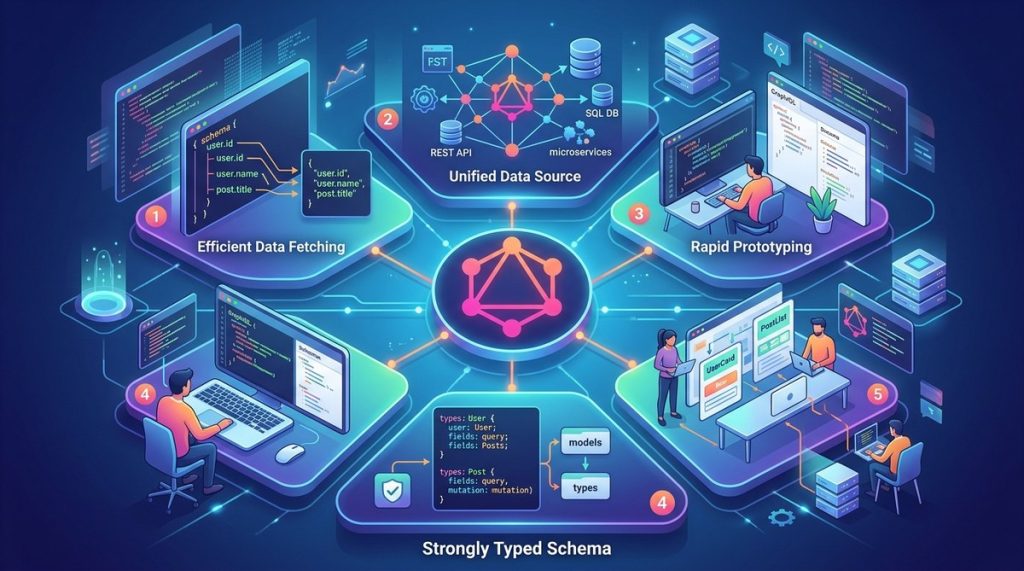
GraphQL solves this at the protocol level. You define a schema. Clients query it. The server responds with only the requested fields. This is not just elegant. It is practical.
Consider a typical Indian ecommerce app. The product listing page needs names, prices, and discount badges. The product detail page needs descriptions, specs, and review counts. With REST, you might build two endpoints. With GraphQL, you build one. The frontend decides.
This is the core value of GraphQL for faster API development. You stop writing boilerplate. You stop maintaining versioned endpoints. You focus on business logic.
How GraphQL Makes API Development Faster: The Core Mechanisms
GraphQL accelerates development in several concrete ways. Let us look at each one.
Single Endpoint Eliminates Route Sprawl
REST APIs grow horizontally. Every new feature adds a new route. /api/users, /api/users/:id/orders, /api/products, /api/products/:id/reviews. The list keeps growing. You need documentation for each one. You need tests for each one.
GraphQL uses a single endpoint. Usually /graphql. Every query and mutation goes there. The schema acts as a contract. The frontend team reads the schema and knows exactly what is available. No more hunting through docs. No more guessing which endpoint returns which fields.
Strong Typing Catches Errors Early
GraphQL schemas are strongly typed. You define types, inputs, and return structures. The server validates every query against the schema before executing it. This means many bugs are caught at development time, not at runtime.
For Indian teams working with distributed setups, this is huge. Your frontend developer in Pune can write a query. The GraphQL validation layer catches a typo in a field name before the query hits the database. That saves debugging time. That saves frustration.
Declarative Data Fetching Reduces Frontend Logic
With REST, the frontend often needs to map responses. The API returns more data than needed. The frontend team writes filtering logic to extract what they need. This is duplicated across screens. It is error prone.
With GraphQL, the frontend declares exactly what it wants. The server returns exactly that. No mapping. No filtering. No wasted effort.
Five Practical Techniques for Faster API Development with GraphQL
These are the five techniques that will change how you build APIs in 2026. Use them. Experiment with them. Make them part of your workflow.
1. Design Your Schema Around Client Needs, Not Database Tables
This is the most important mindset shift. REST developers often mirror database tables. A users table becomes a /users endpoint. An orders table becomes an /orders endpoint. This works. But it creates friction.
GraphQL lets you design schemas that match how the client actually uses data. Think about screens. Think about user journeys. Think about what data belongs together from the client’s perspective.
For example, a dashboard for a Swiggy style food delivery app might need:
- The user’s name and default address
- Active orders with restaurant name and delivery time
- Recent past orders with ratings
Instead of three REST calls, you build one GraphQL query. The schema groups data by usage, not by table.
query Dashboard {
  user {
    name
    defaultAddress
  }
  activeOrders {
    restaurantName
    estimatedDelivery
  }
  recentOrders(limit: 5) {
    restaurantName
    rating
  }
}
2. Use DataLoader to Eliminate N+1 Queries
The N+1 problem is the most common performance pitfall in GraphQL. It happens when a resolver fetches a list of items and then fetches related data for each item individually. If you fetch 100 orders and then fetch the customer for each order, that is 101 database queries.
DataLoader batches and caches these requests. It collects all the keys from a single tick of the event loop and sends them in one batch query. This reduces database round trips dramatically.
Install DataLoader. Set up batch functions for your most common data fetching patterns. Your API will thank you.
| Technique | Problem Solved | Typical Performance Gain |
|---|---|---|
| Schema first design | Mismatch between backend and frontend needs | 30 percent less code |
| DataLoader batching | N+1 database queries | 50 to 80 percent fewer DB calls |
| Query complexity analysis | Expensive queries crashing the server | Prevents abuse entirely |
| Persisted queries | Large query strings over slow networks | Reduces payload by 60 percent |
| Federation | Monolithic GraphQL server scaling limits | Horizontal scaling per domain |
3. Implement Query Complexity Analysis for Safety
GraphQL gives clients a lot of power. That power needs guardrails. A malicious or naive client can write a deeply nested query that joins many tables and brings your server to its knees.
Query complexity analysis assigns a cost to each field. A field that fetches from a database might cost 5 points. A field that fetches from a cache might cost 1 point. You set a maximum cost per query. When a query exceeds that limit, the server rejects it.
This is not about restricting your users. It is about protecting your infrastructure. Indian startups running on tight cloud budgets cannot afford runaway queries.
4. Use Persisted Queries for Mobile Clients
Mobile networks in India have improved. But they are still variable. A user in a metro city might have great connectivity. A user in a smaller town might not. Large query strings add to the payload.
Persisted queries solve this. You generate a unique hash for each query. The client sends only the hash. The server looks up the full query from a store. This reduces request size. It also prevents arbitrary queries from unknown clients.
This technique pairs beautifully with tools like Apollo. Your mobile app becomes faster. Your server becomes more secure.
5. Adopt Federation for Growing Teams
As your startup grows, your GraphQL schema grows too. A single monolithic GraphQL server becomes hard to maintain. Different teams want to own different parts of the schema.
Federation lets you split your schema across multiple services. Each team owns their domain. A user service owns user types. An order service owns order types. A gateway stitches them together into a single unified schema.
This is how large Indian companies like Razorpay and Zerodha structure their GraphQL layers. It keeps development fast even as teams scale.
Common Mistakes That Slow Down GraphQL Development
Even experienced developers make these mistakes. Avoid them to keep your GraphQL for faster API development efforts on track.
- Treating GraphQL like REST: Writing separate resolvers that mirror REST endpoints defeats the purpose. Think in graphs, not in routes.
- Ignoring error handling: GraphQL returns 200 OK even when errors occur. Handle errors explicitly in your resolvers. Return meaningful messages.
- Skipping input validation: GraphQL types validate field types but not business rules. Validate inputs in your resolver logic.
- Overusing resolvers for simple transforms: If you are just renaming a field, do it in the schema. Do not write a resolver for it.
“GraphQL changed how we build at my startup. We went from two weeks to build a new API endpoint to one day. The frontend team stopped waiting for backend changes. They just wrote queries. That speed is everything when you are competing in the Indian market.” – Priya Sharma, Backend Lead at a Bangalore based fintech startup.
How to Measure Success with GraphQL
You have adopted GraphQL. How do you know it is working? Track these metrics.
- Time to ship a new frontend screen: Measure from ticket creation to deployment. GraphQL should reduce this by 30 percent or more.
- Payload size per request: Compare average payload sizes before and after. A 40 percent reduction is common.
- Number of endpoints or resolvers: A growing REST codebase adds routes. A well designed GraphQL schema stays stable. Track how often you need to add new fields.
- Developer satisfaction: Run a team survey. Ask how easy it is to find and use data. GraphQL teams consistently report higher satisfaction.
Your Next Steps for Faster API Development
You do not need to migrate everything overnight. Start small. Pick one feature or one microservice. Build a GraphQL layer in front of it. Let your frontend team experiment. Measure the results.
As you gain confidence, expand. Add more types. Bring in more services. Soon, your entire API surface will be GraphQL.
If you want to stay ahead of the curve, check out the latest top web development trends to boost your business in 2026. GraphQL is central to many of them.
Also, make sure your development environment is set up right. The right essential web development tools every startup should use will make your GraphQL journey smoother.
And if you are building for mobile heavy audiences in India, do not miss our guide on 7 best practices for optimizing web applications for Indian mobile users in 2026.
Building for the Next Wave of Indian Tech
GraphQL is not just a technology choice. It is a productivity choice. It aligns backend and frontend teams. It reduces time to market. It lowers infrastructure costs. And in a market where speed determines winners and losers, that makes all the difference.
Start today. Write your first schema. Let your frontend team write their first query. Feel the difference when they get exactly the data they need, nothing more, nothing less.
Your users will notice. Your team will notice. And your business will grow faster because of it.