A showroom in Mumbai lets you touch the fabric of a sofa, see the exact shade of teak wood, and test the firmness of a cushion. Your online store cannot offer that physical touch, but it can offer the next best thing: total control. In 2026, shoppers in India expect to build their own product, not just pick from a static list. They want to choose the colour of a phone case, the engraving on a laptop, or the handlebar grips on a bicycle. If your site cannot deliver that experience, they will leave for a competitor who can. That is why an e-commerce product configurator 2026 is no longer a luxury. It is a necessity for survival and growth.
A customizable product configurator turns passive browsing into active creation. It reduces returns by up to 30% because customers see exactly what they will receive. It increases average order value through smart upselling. In 2026, Indian shoppers expect personalisation. Your e-commerce site must deliver it to stay competitive and boost conversion rates.
What a Product Configurator Actually Does
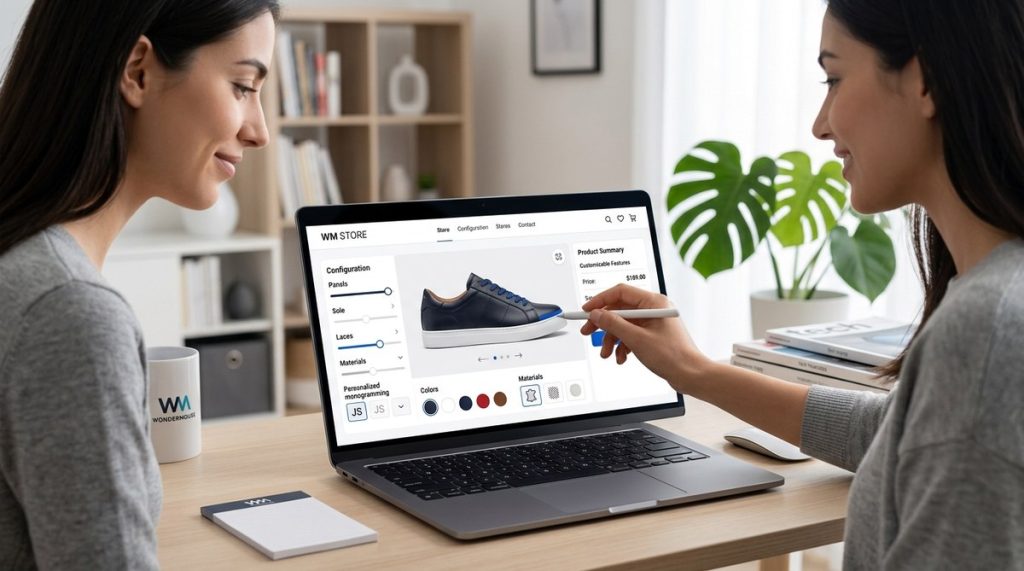
A product configurator is an interactive tool on your website. It lets customers customise a product before they add it to the cart. They can change colours, materials, sizes, add text, or swap components. The tool updates the price and the product image in real time.
Think about buying a pair of shoes on a site that only shows one image. You wonder if the colour looks different in natural light. You worry the size might be wrong. Now imagine a configurator where you spin the shoe 360 degrees, change the laces to neon yellow, and see the total price change as you add extra cushioning. That is the difference.
In India, where festivals like Diwali and wedding seasons drive massive e-commerce spikes, a configurator can be the difference between a browsing session and a confirmed order.
Why 2026 Is the Year for Customisation
The Indian e-commerce market is crowded. Platforms like Myntra, Amazon, and Flipkart already offer basic customisation. But the real shift in 2026 is customer expectation. People no longer want a one-size-fits-all product. They want something that reflects their identity.
Here are three reasons why this year matters:
- Mobile-first shopping: Over 75% of e-commerce traffic in India comes from mobile devices. A configurator built for mobile keeps users engaged on the small screen.
- Return fatigue: Customers are tired of ordering three sizes and returning two. A visual configurator reduces uncertainty and returns.
- Social sharing: A customised product screenshot gets shared on WhatsApp and Instagram. That is free marketing for your brand.
How a Configurator Directly Boosts Conversion Rates
Let us look at the hard numbers. According to industry data, sites with product configurators see conversion rate increases of 20% to 40%. Why does this happen?
- Emotional investment: When a customer spends five minutes designing their product, they feel ownership. They are less likely to abandon the cart.
- Price transparency: No hidden fees. The price updates as they add features. This builds trust.
- Reduced choice paralysis: A configurator guides the customer through options step by step. It prevents the overwhelming feeling of a hundred static product pages.
For example, a furniture store in Delhi implemented a configurator for modular kitchens. Customers could drag and drop cabinet styles, countertop colours, and handle designs. The store reported a 35% increase in average order value because customers naturally added premium upgrades when they saw the visual impact.
The Technical Side: What Makes a Good Configurator
Building a configurator is not just about slapping a colour picker on a page. It requires thoughtful engineering. Here is a breakdown of the key features and common mistakes.
| Feature | Why It Matters | Common Mistake to Avoid |
|---|---|---|
| Real-time 3D preview | Lets customers rotate and zoom the product. Builds confidence. | Using low-resolution images that look pixelated on mobile. |
| Dynamic pricing | Shows the price change with every option selected. | Hiding the price update until the end. |
| Validation logic | Prevents customers from selecting incompatible options (e.g., a red frame with a green strap that does not match). | Allowing any combination, which leads to impossible orders. |
| State persistence | Saves the customisation if the customer leaves and comes back. | Losing the design when the session expires. |
| Mobile responsiveness | The tool works smoothly on a 6-inch screen. | Using desktop-only drag-and-drop that fails on touch. |
Expert advice: Start with a simple configurator for your bestselling product. Test it for a month. Gather feedback. Iterate. Do not try to build the perfect configurator for your entire catalogue at once. That is a recipe for a delayed launch and a blown budget.
Step-by-Step: How to Implement a Configurator
If you are ready to move forward, follow this practical process. It will save you time and money.
- Identify the right product: Choose a product that has at least three customisable attributes. For example, a backpack with colour, strap type, and monogramming. Avoid products with only one attribute.
- Map the options and rules: List every possible combination. Then define the rules. For instance, if a customer chooses a leather strap, the canvas strap option disappears. This prevents confusion.
- Choose your technology: You can use a plugin for platforms like Shopify or WooCommerce, or build a custom solution with JavaScript and a 3D engine. For most Indian startups, a plugin is the best starting point. Check out our guide on essential web development tools every startup should use for recommendations.
- Design the user interface: Keep it simple. Use large buttons, clear icons, and a prominent “add to cart” button. Avoid clutter.
- Test on real devices: Do not just test on a desktop. Test on a budget Android phone, an iPhone, and a tablet. Fix any lag or broken layout.
- Launch with a campaign: Announce the configurator via email, social media, and a banner on your homepage. Offer a small discount for the first 100 custom orders.
Common Pitfalls That Will Hurt Your ROI
Even a well-designed configurator can fail if you ignore these mistakes.
- Too many options: Giving customers 50 colours and 30 materials creates paralysis. Limit choices to 8 to 12 per attribute.
- Slow loading times: A configurator that takes more than 3 seconds to load will lose half its visitors. Optimise your images and use a content delivery network. Read about how to optimize core web vitals for better rankings in 2026 to improve performance.
- No mobile optimisation: If the buttons are too small to tap on a phone, the configurator is useless.
- Ignoring the backend: The configurator must talk to your inventory system. If someone orders a custom product, your team needs to know exactly what was selected. A mismatch leads to angry customers.
Measuring Success: What to Track
Once your configurator is live, track these metrics:
- Engagement time: How long does a user spend in the configurator? Longer time usually means higher intent.
- Conversion rate: Compare the conversion rate of product pages with and without the configurator.
- Average order value: Are customers adding more expensive options?
- Return rate: Are returns lower for configurator products compared to standard products?
- Abandonment rate: At which step do users leave? If they drop off at the price summary, your pricing might be unclear.
Industries in India That Benefit the Most
While any e-commerce store can use a configurator, some industries see exceptional results.
- Furniture and home decor: Customers want to see how a sofa looks in their preferred fabric colour.
- Apparel and accessories: Custom sizing, colour combinations, and monogramming are popular.
- Jewellery: Let customers choose the metal, stone, and chain style.
- Automotive accessories: Customising seat covers, steering wheels, or helmet designs.
- Electronics: Custom laptop skins, phone cases, and keyboard keycaps.
A jewellery brand in Jaipur used a configurator to let brides design their own necklace for the wedding season. The brand saw a 50% increase in average order value because brides selected more gold and gemstones when they could see the final piece.
The Future of Configurators in India
By 2026, AI will play a larger role. Imagine a configurator that suggests options based on a customer’s past purchases or browsing history. “You liked the blue saree last month. Try this blue border for your custom blouse.” That is not science fiction. It is the next logical step.
Additionally, integration with augmented reality will become standard. A customer will point their phone camera at their living room and see how a customised sofa fits in the corner. For Indian businesses, this is a massive opportunity to reduce the gap between online and offline shopping.
Make the Investment Now
You have seen the data. You understand the benefits. The only question left is when to start. Waiting until 2027 means giving your competitors a full year of head start. A customizable product configurator is not a trend. It is a fundamental shift in how people shop online. Indian customers are ready for it. Your technology stack can handle it. The only missing piece is your decision to act.
Start small. Pick one product. Build one configurator. Learn from it. Then expand. Your customers will thank you with higher engagement, more orders, and fewer returns. And that is the kind of growth every e-commerce store needs in 2026.