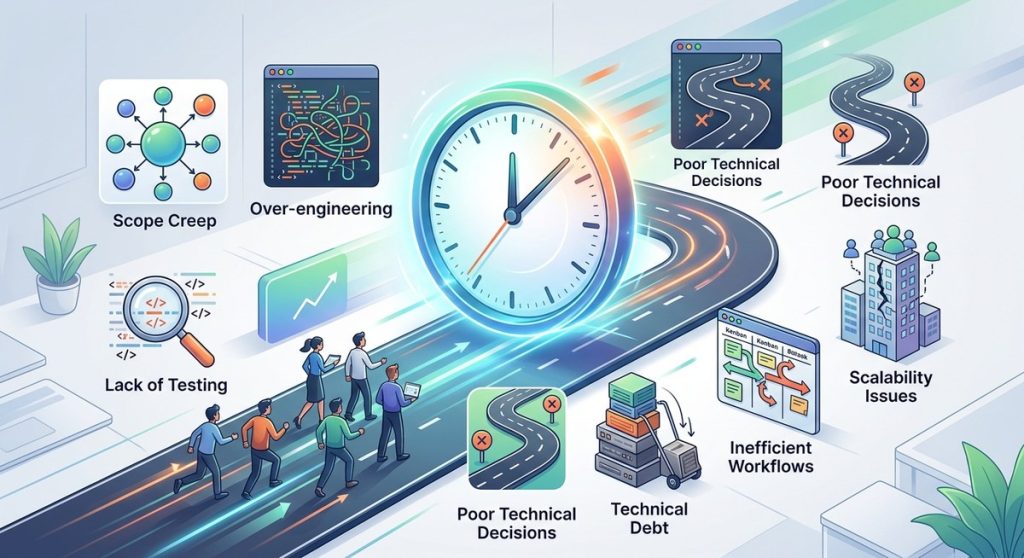
Your team has been working on the product for three months. The budget is running low. The launch date has moved twice already. You ask your lead developer for a status update, and you hear the words every founder dreads: "We need to refactor the codebase." This scenario plays out in countless Indian startups every year. The frustration is real. You are not alone. The good news is that most of these delays come from a handful of predictable mistakes. Once you know what they are, you can avoid them.
Most startup delays in web development come from five common pitfalls: unclear requirements, technology over-engineering, ignoring mobile users, skipping performance checks, and poor communication between founders and developers. This guide shows you how to spot each trap and gives you practical steps to keep your product launch on schedule.
Why Your Startup Keeps Missing Deadlines
You have a great idea. You hired a team. You expected a working product in four months. Now you are looking at eight months and counting. The problem is rarely the developers' skill. The problem is almost always a series of small, avoidable mistakes that compound over time. These are the specific web development pitfalls slow startup growth in India more than anywhere else.
Let us look at the five biggest traps and how to sidestep each one.
Pitfall 1: The Shifting Requirements Trap
This is the single biggest killer of startup timelines. You start with a clear feature list. Then your beta testers ask for something new. Then an investor suggests a change. Then you see a competitor launch something cool. Before you know it, your team is building features nobody asked for while the core product remains unfinished.
How to fix it:
- Freeze the feature set for the first version.
- Write down every new idea in a "future version" document.
- Ask one question before any change: "Does this block the launch?"
- Review the scope every week with your tech lead.
- Say no to everything that does not directly solve your customer's main problem.
A simple rule helps here: if the feature is not critical for the first 100 paying users, it does not belong in version one.
Pitfall 2: Choosing the Wrong Tech Stack
Many founders let their developers pick the technology. That sounds reasonable. But developers often choose tools because they are new and exciting, not because they are stable and fast to build with. A complex stack with microservices, multiple databases, and three different programming languages might look impressive on a resume, but it will slow your launch to a crawl.
Here is a comparison of common technology choices and their impact on delivery time:
| Technology Choice | Time to Build MVP | Maintenance Effort | Hiring Difficulty |
|---|---|---|---|
| Single framework (e.g., Django or Laravel) | 2 to 4 months | Low | Easy |
| React + Node.js | 3 to 5 months | Medium | Medium |
| Microservices with separate backends | 6 to 12 months | High | Hard |
| Custom blockchain or AI integration | 8+ months | Very High | Very Hard |
"The best technology for your startup is the one your team already knows well. Novelty adds months to your timeline." -- Ankita Sharma, CTO of a Delhi based SaaS startup
Stick with what works. You can always rebuild later when you have revenue.
Pitfall 3: Ignoring Mobile Users Until the End
India has over 750 million smartphone users. Your website will likely be opened on a phone first. Yet many startups build the desktop version first and treat mobile as an afterthought. This is a critical mistake. Mobile users in India have different expectations. They use slower internet connections. They expect pages to load in under three seconds. They want thumb friendly buttons and simple navigation.
What to do instead:
- Design for mobile first from day one.
- Test on real devices, not just browser simulators.
- Optimize images and scripts for low bandwidth.
- Use a content delivery network with servers in Mumbai, Delhi, and Bangalore.
- Run speed tests on a 4G connection before launch.
For more on this topic, read our guide on how to build responsive web designs that drive Indian users engagement in 2026.
Pitfall 4: Skipping Performance Checks Until Launch
Your developers tell you they will optimize the code later. That is a dangerous promise. Performance is not something you add at the end. It is something you build into every step. When you skip performance checks, you end up with a slow, bloated application that frustrates users and hurts your SEO.
Common performance mistakes founders overlook:
- Uncompressed images that take ten seconds to load
- Database queries that run hundreds of times per page load
- JavaScript files that block the page from rendering
- No caching strategy for repeat visitors
- Third party scripts that slow everything down
Check your core web vitals for better rankings in 2026 before you launch. A one second delay in page load time can cut your conversions by 7 percent. For a startup with a 5 percent conversion rate and 10,000 monthly visitors, that is 35 lost sales every month.
Pitfall 5: Poor Communication Between You and Your Developers
You speak business. Your developers speak code. These two languages do not always translate well. You say "add a login feature." Your developer hears "build a complete authentication system with OAuth, password reset, and two factor authentication." You get a bill for two weeks of work when you expected two days.
A numbered process for better communication:
- Write user stories instead of feature requests. "As a customer, I want to log in with my email and password so I can access my orders."
- Ask for a time estimate in hours, not days.
- Request a visual mockup before any code is written.
- Hold a 15 minute standup every morning.
- Use a shared project management tool where both sides update tasks daily.
This approach removes ambiguity. It also builds trust. When both sides understand what is being built, timelines become more predictable.
Pitfall 6: Building Everything From Scratch
Founders love the idea of building something unique. But most startup features are not unique. User registration, payment processing, email notifications, and content management have been built thousands of times. You do not need to rebuild them.
Tools and services that save months of work:
- Payment gateways like Razorpay or Cashfree for UPI and card payments
- Authentication services like Auth0 or Firebase
- Email services like SendGrid or Mailgun
- CMS platforms like WordPress or Strapi for content
- Hosting platforms with one click deployment
Build only what makes your product different. Buy or use open source for everything else. This alone can cut your development time by 40 percent.
For Indian startups, integrating UPI payments into your web app with Node.js is now straightforward with modern APIs. Do not waste time building a payment system from scratch.
Pitfall 7: Not Planning for Scale From the Start
You do not need Twitter scale infrastructure on day one. But you do need a foundation that can grow. Many startups build everything on a single server with a single database. When traffic spikes, the whole site crashes. You lose customers and credibility.
What you should do instead:
- Use a database that can be upgraded without downtime
- Separate your application logic from your database
- Use environment variables for configuration
- Write automated tests for critical paths
- Set up monitoring from the first deployment
You do not need to spend lakhs on cloud infrastructure. A simple setup with a load balancer and two application servers can handle thousands of concurrent users. The key is to avoid code that is tied to a specific server or database.
How to Build a Realistic Timeline
Most founders underestimate development time by 50 to 100 percent. This is not because developers are slow. It is because building software involves unknowns. You cannot predict every bug or integration issue.
A better way to estimate:
- Take the developer's estimate and multiply by 1.5
- Add 20 percent for testing and bug fixes
- Add 15 percent for meetings and communication
- Add 10 percent buffer for unexpected problems
This gives you a realistic timeline. Share this with your investors and stakeholders upfront. It is better to under promise and over deliver than the opposite.
Putting It All Together
Here is a checklist you can use for your next project:
- [ ] Feature set is frozen for version one
- [ ] Tech stack is simple and familiar to the team
- [ ] Mobile design is complete and tested
- [ ] Performance checks are automated in the build process
- [ ] Communication process is agreed upon by both sides
- [ ] Third party services handle all non core features
- [ ] Infrastructure can handle a 10x traffic spike
- [ ] Timeline includes realistic buffers
Your First Step Toward Faster Launches
You now know the seven common web development pitfalls slow startup growth. The next step is to sit down with your technical lead and review your current project against this list. Pick the one area where you are weakest and fix it this week. Do not try to fix everything at once.
Start with communication. Set up a daily standup. Write user stories. Ask for time estimates in hours. These small changes will build momentum. Once you see the improvement in your team's output, move on to the next fix.
Your product deserves to reach the market. Your customers are waiting. Do not let avoidable mistakes hold you back.
For more practical advice, check out our guide on essential web development tools every startup should use and learn how to boost your website performance with these proven development strategies.