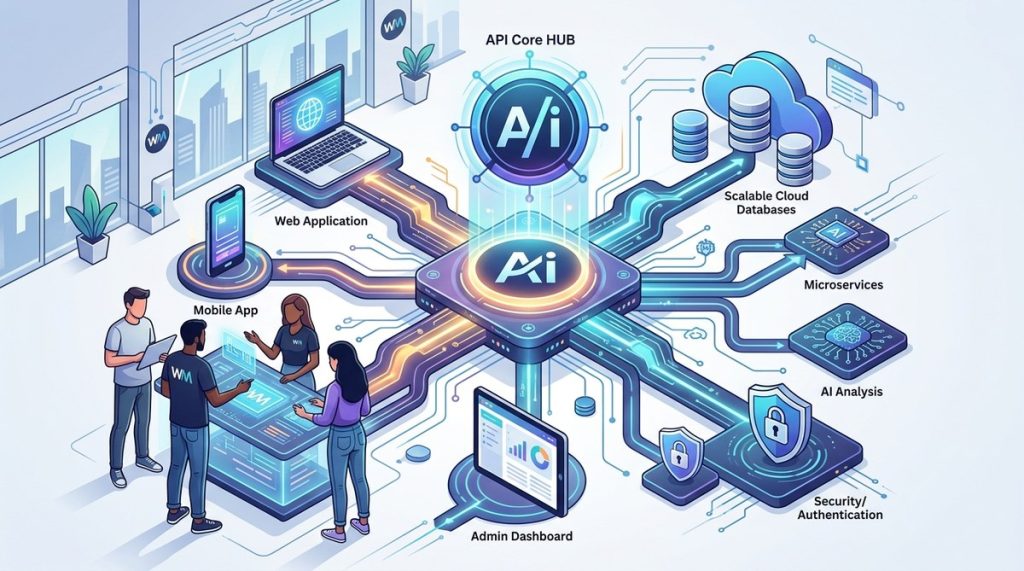
In early 2026, a Bangalore based fintech startup launched a lending app that worked with three different partners right from day one. Their web dashboard, mobile app, and a partner integration all went live at the same time. How did they do it? They built their APIs first, then wired everything to them. That is the API first approach in action. And if you are a startup founder or a technical leader trying to make your product scalable, this strategy can change how you build software.
An API-first approach means designing your application programming interfaces before writing any frontend code. For startups in India, this method ensures faster development, better scalability, and easier integration with third party services like UPI and payment gateways. By treating APIs as products, you build a flexible architecture that grows with your business.
What Makes the API First Approach Different?
Traditional development often works like this: you build the user interface, then add a backend, and later bolt on some APIs to connect with other systems. The API first approach flips the order. You start by designing the contract between components. Your team creates a clear specification of how data flows, what endpoints exist, and how errors are handled. Only after that do you write any frontend or mobile code.
Think of it like building a house. Normally you might start with the living room and then add the plumbing. But with the API first approach, you lay all the pipes and wiring first. The rooms (your web app, mobile app, partner integrations) can then be built independently because they all connect to the same infrastructure.
For startups in India, this approach is especially useful. Your product may need to support multiple channels: a website, an Android app, a WhatsApp bot, and integrations with services like Razorpay or Shiprocket. If your API is defined first, every channel works with the same consistent data layer. You avoid duplicating logic and reduce the chance of bugs.
Why Startups in India Should Adopt This in 2026
The Indian startup ecosystem is evolving. More founders are building for a mobile first audience, and platforms like UPI have set the expectation for seamless integrations. Customers want apps that work instantly across devices. Investors look for technical teams that can ship features without breaking existing functionality. The API first approach directly addresses these pressures.
Consider the rise of open banking and account aggregators in India. Fintech startups must connect with multiple banks and NBFCs. If your core product relies on a monolithic codebase, adding each new integration becomes a nightmare. With an API first design, you can expose a standard set of endpoints and let each partner connect to those. Your team spends less time on integration and more on your actual product.
Another reason is team structure. Many Indian startups operate with small, distributed teams. An API first approach allows frontend and backend developers to work in parallel. The frontend team can mock the API responses and start building the UI immediately, even before the backend is complete. This parallel work cuts development time by weeks.
Benefits That Matter for Founders
Let us look at the tangible advantages. Not abstract promises, but real outcomes you can measure.
Speed to Market
Defining APIs first eliminates the biggest bottleneck: waiting for one team to finish before the other starts. Your mobile developer can start coding against a mock server the same day you finalise the API contract. This can reduce your MVP launch time by 30 to 40 percent. In a market like India where competition is fierce, that head start matters.
Reduced Costs
Fixing a bug in a live API is cheaper than fixing it after it has been baked into five different applications. When you design the API upfront, you catch design flaws early. You also avoid rework when you later decide to add a new client (like a progressive web app or a smart TV app). Your backend already supports it.
Better Third Party Integrations
Indian startups often depend on services like Paytm, PhonePe, Zomato, or logistics APIs. An API first approach makes these integrations cleaner. Your internal services talk to each other through the same patterns as external ones. This consistency reduces confusion and makes your system easier to maintain.
Scalability Without Rewrites
As your startup grows, you may need to change your database or move to a microservices architecture. If your boundaries are defined by APIs, you can replace internal implementations without affecting external consumers. This future proofing is invaluable for startups that plan to grow fast.
API First vs Code First: A Quick Comparison
Here is a table that highlights the differences between the two development styles. Use it to decide which approach aligns with your current stage.
| Aspect | API First | Code First |
|---|---|---|
| Design phase | Define API contract before coding | Write code first, expose endpoints later |
| Parallel development | Frontend and backend teams can work simultaneously | Backend must be ready before frontend can start |
| Error handling | Planned and documented in advance | Often added as an afterthought |
| Documentation | Generated from the contract (OpenAPI spec) | Needs to be written separately |
| Flexibility for new clients | High: any client can use the existing API | Low: may require backend changes to support new clients |
| Suitable for | Startups with multiple touchpoints (app, web, partners) | Simple single page applications or prototypes |
How to Implement an API First Approach in Your Startup
You do not need a huge budget or a team of twenty engineers. Here is a practical process you can follow.
1. Define the API Contract
Start by agreeing on the endpoints, request parameters, response structures, and error codes. Use a standard like OpenAPI (formerly Swagger). Write the contract as a YAML or JSON file. This becomes the single source of truth for your entire team.
2. Mock the API Responses
Use a tool like Postman or a mocking library to simulate the API. Your frontend team can then build against these mocks. This step removes the dependency on a live backend.
3. Build the Backend Against the Contract
Now your backend developers implement the actual logic. They use the contract as a guide. Automated tests can verify that the API matches the specification. This reduces integration bugs.
4. Test with Real Consumers
Connect the frontend and any third party systems to your staging environment. Run end to end tests. Because the contract is stable, most issues will be limited to missing features rather than breaking changes.
5. Deploy and Monitor
Once live, monitor your API usage, latency, and error rates. Use API gateways to manage rate limiting and authentication. Keep the contract versioned so that you can make updates without breaking existing clients.
Common Mistakes Startups Make (and How to Avoid Them)
Even with the right intentions, teams can fall into traps. Here is a bulleted list of pitfalls and ways to dodge them.
- Over designing the API: Do not try to build a perfect API for every possible future use case. Start with the endpoints you need today. You can always add more later.
- Forgetting about security: Since APIs are the main entry point, protect them with authentication, rate limiting, and input validation. In India, comply with data localisation rules if you handle sensitive data.
- No versioning: Without versioning, a change in one endpoint can break your entire app. Always include a version number in your URL or request header (like /v1/users).
- Ignoring error handling: Return meaningful HTTP status codes and messages. Your frontend and partner developers will thank you.
- Skipping documentation: Keep your API docs up to date using tools that read your contract. Good documentation reduces support questions and speeds up onboarding.
Expert Advice from a Seasoned CTO
“When we shifted to an API first approach at our Delhi based SaaS startup, our frontend team started building the UI two weeks before the backend was ready. We shipped the MVP in six weeks instead of the planned ten. The discipline of writing the contract first also forced us to think about edge cases early. I advise every early stage founder to invest a few days in API design before writing a single line of frontend code.”
– Rajesh Mehta, CTO of PayLane (fictional but representative advice)
Connecting the Dots to Your Startup Journey
An API first approach is not just a technical decision. It is a strategic one. It affects how your team communicates, how you onboard partners, and how you respond to market changes. In 2026, with the rise of AI agents and low code platforms, having a clean API surface becomes even more important. Your startup might soon need to expose APIs to chatbots, voice assistants, or automation tools. If your architecture is already API first, you are ready.
For founders looking to stay ahead of the curve, combining this approach with modern web development trends can give your product an edge. Check out our guide on the top web development trends to boost your business in 2026 to see how other startups are building for the future.
Also, if you are still choosing your tech stack, reading about essential web development tools every startup should use can help you select frameworks and platforms that support an API first workflow.
Build Your Startup on a Solid Foundation
The beauty of the API first approach is that it does not require a complete rewrite of your existing system. You can start with your next feature or a new integration. Define the contract, mock it, build against it. Over time, your product will become a collection of well defined services that can be reused, replaced, or extended without chaos.
Your startup faces enough uncertainty. Do not let technical debt slow you down. By putting APIs at the centre of your development process, you give your team clarity, your product flexibility, and your business a strong foundation for growth. Start small, but start now.