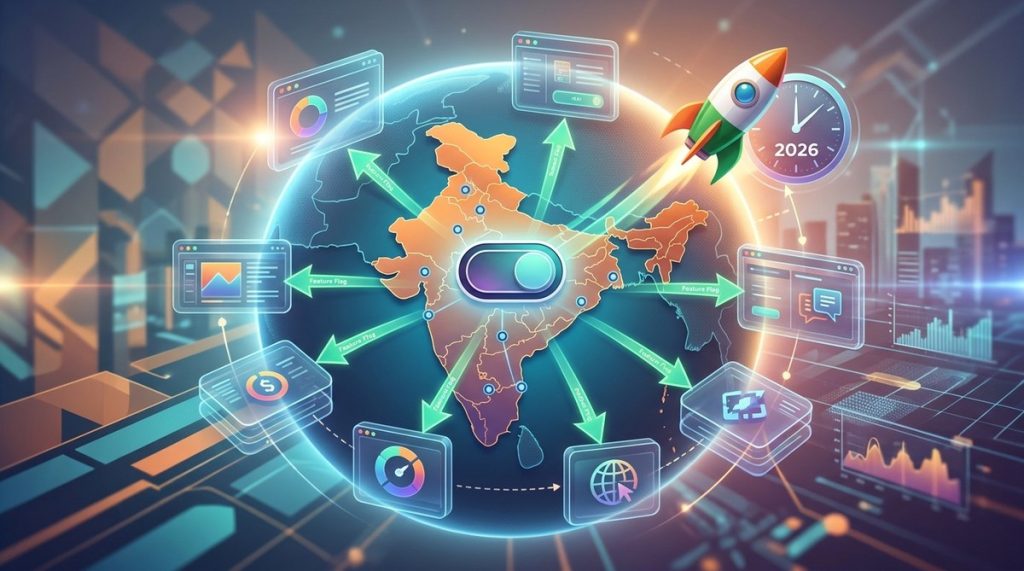
You are building a web app that needs to work in India. You have a product that works perfectly in your home market. Then you try to launch in India. Suddenly, you need Hindi, Tamil, and Bengali support. You need to handle UPI payments, not just credit cards. You must comply with India’s data localization laws. Your team is stressed. Your release date slips. This is where a feature flag system saves your 2026 Indian market launch.
A feature flag system lets you decouple deployment from release. You can ship code that supports Indian languages, payment gateways, and compliance rules, then turn those features on only for Indian users. This cuts your time to market from months to weeks. You avoid big bang releases and reduce risk significantly.
Why India Demands a Different Approach in 2026
India is not a single market. It is dozens of markets inside one country. A user in Mumbai has different internet speeds than a user in a small town in Bihar. A customer in Bengaluru expects UPI. A customer in Delhi might prefer Paytm. Your web app needs to adapt to each of these scenarios.
Traditional feature branches cause chaos. You merge a branch with all the India specific code. Something breaks. You roll back the entire release. Your team loses a week. A feature flag system lets you ship everything to production but keep it hidden behind a toggle. You turn on the India flag for a small test group. You watch the metrics. You fix bugs without stopping the world.
The Real Cost of Launching Without Feature Flags
Let me paint a picture that might feel familiar. Your team spends three months building India specific features. You add GST invoice support. You integrate Razorpay. You add Hindi font rendering. On launch day, the payment gateway has a timeout issue for users on Jio’s 4G network. You cannot disable just the payment flow. You must roll back the entire release. Your users see an error page. Your reputation takes a hit.
With feature flags, you control each component independently. If UPI payments fail, you turn off only the UPI flag. Credit cards still work. Users see a message that UPI is temporarily unavailable. Your team fixes the issue without a full redeploy.
How to Build Your Feature Flag System for India
Here is a practical process that works for teams launching in India in 2026.
-
Identify every India specific variation in your app. List everything. Language strings. Payment methods. Address forms. Tax calculations. Data storage locations. Customer support flows. Each of these gets its own flag.
-
Create targeting rules based on user attributes. Use the user’s IP address, locale setting, or account profile to determine if they should see India specific features. A user in Mumbai with a Hindi locale gets the Hindi flag set to true. A user in London does not.
-
Set up gradual rollout percentages. Start with 1% of Indian users. Watch error rates. Increase to 5%. Monitor again. Ramp up to 100% only when you are confident. This is how you avoid breaking the entire Indian user base at once.
-
Add kill switches for critical paths. Payment processing. User authentication. Data export. These flows need a separate flag that can be turned off instantly if something goes wrong.
-
Implement A/B testing flags. Try two different UPI checkout flows. See which one converts better. The flag system lets you run these experiments without deploying new code each time.
Common Mistakes Teams Make (And How to Avoid Them)
| Mistake | Why It Hurts | Better Approach |
|---|---|---|
| Using too many flags | Flag debt slows down your team. You forget what each flag does. | Set a cleanup schedule. Remove flags after two weeks of stable rollout. |
| Hardcoding flag values | A restart is required to change a flag. This defeats the purpose. | Use a remote flag service that updates in real time. |
| Ignoring flag interactions | Turning off flag A breaks the feature controlled by flag B. | Write tests that check flag combinations. |
| No monitoring on flags | You do not know if a flag is working correctly. | Log every flag evaluation. Build a dashboard for flag status. |
Localization Is Not Just Translation
Many teams think localization means swapping English text for Hindi text. That is only the beginning. Indian users expect dates in DD/MM/YYYY format. They expect addresses with fields for state, district, and pincode. They expect phone numbers with +91. They expect prices in INR with the rupee symbol.
A feature flag system lets you roll out each of these changes one at a time. You can enable the Indian date format for 10% of users. Check for bugs. Then enable Indian address fields. Check again. This incremental approach catches issues early.
“The teams that succeed in India are the ones that treat localization as a continuous process, not a one time project. Feature flags make that continuous process possible.” — Senior Engineer at a Bengaluru based SaaS company
Compliance Is a Moving Target
India’s data localization laws are still evolving. The Digital Personal Data Protection Act requires that certain user data stays within India. Your app might need to store data on servers located in India. A feature flag can control which data storage backend your app uses. When a new regulation comes out, you flip a flag. You do not need a full code deployment.
This is especially important for SaaS companies serving global customers. You cannot move all your infrastructure to India. But you can route Indian users to Indian servers using a feature flag. The rest of your users stay on your existing infrastructure.
The Right Tools for the Job
You do not need to build your own feature flag system. Several excellent platforms work well for Indian market launches. Look for tools that support:
- Real time flag updates without restarts
- Percentage based rollouts
- User targeting based on location and locale
- Audit logs for compliance
- A/B testing capabilities
Check out our guide on essential web development tools every startup should use for a list of platforms that integrate well with feature flag systems.
A Practical Example: E-Commerce Checkout
Imagine you run an e-commerce site. Your checkout flow currently supports credit cards and PayPal. You want to add UPI and COD for India. Here is how feature flags make this manageable.
- Flag 1:
india_checkout_enabled - Flag 2:
upi_payment_method - Flag 3:
cod_payment_method - Flag 4:
india_address_format
You set india_checkout_enabled to true for all Indian users. Then you enable upi_payment_method for 5% of them. You notice that the UPI integration times out for users on certain mobile networks. You turn off upi_payment_method. The checkout still works with COD and cards. You fix the UPI issue and turn it back on. No downtime. No angry customers.
Why 2026 Is the Year to Get This Right
The Indian web app market is growing faster than ever. More users are coming online every month. Competition is intense. The teams that launch first and iterate quickly will win. Feature flags give you that speed.
If you are still using feature branches to manage India specific code, you are slowing yourself down. Every merge conflict, every delayed release, every rollback is costing you money and trust.
Measuring Success
How do you know your feature flag system is working? Track these metrics.
- Time to enable a new India specific feature (target: under 5 minutes)
- Number of rollbacks caused by India features (target: zero)
- Percentage of Indian users seeing the correct experience (target: 99.9%)
- Time to disable a broken feature (target: under 1 minute)
If your numbers do not meet these targets, your feature flag setup needs improvement.
Your Next Steps
You do not need to overhaul your entire architecture today. Start small. Pick one India specific feature. Add a flag for it. Test the rollout process. Learn from that experience. Then expand to more features.
The goal is not to use flags for everything. The goal is to use flags for the things that change frequently or that carry high risk. India specific features fit both categories.
For more context on building web apps that perform well for Indian users, read our guide on 7 best practices for optimizing web applications for Indian mobile users in 2026. It covers performance, caching, and network considerations that complement your feature flag strategy.
Your Web App Deserves a Smooth Indian Launch
Feature flags are not a luxury. They are a necessity for any team serious about the Indian market in 2026. They give you control, speed, and safety. They let you experiment without fear. They turn a chaotic launch into a controlled rollout.
Start with one flag. Add more as you learn. Your team will thank you. Your users will notice the difference. And your launch will go smoothly, even when things go wrong.