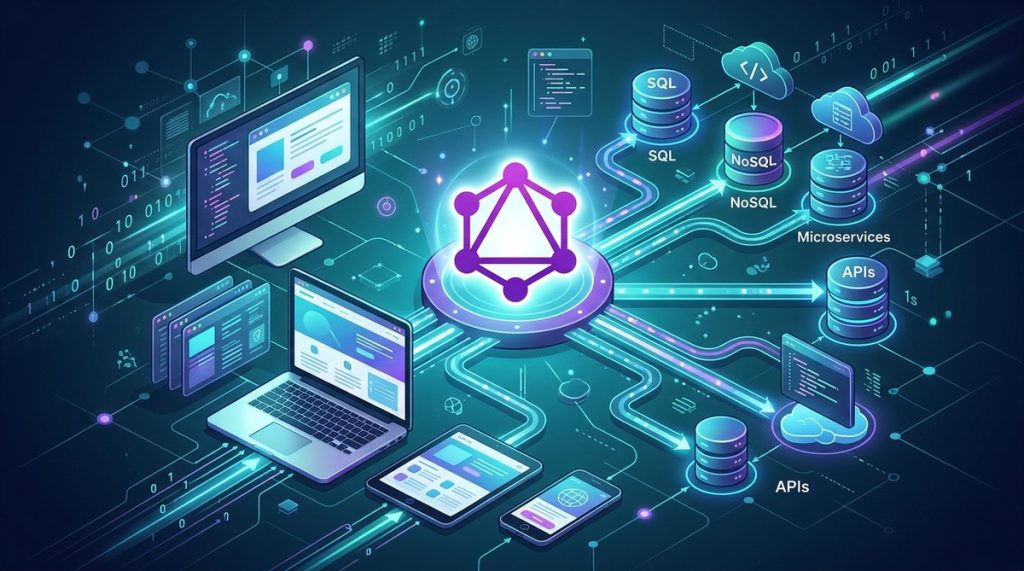
The debate between REST and GraphQL has been running for years. In 2026, that debate is mostly settled for anyone building a new web application. The question is no longer if you should use GraphQL, but how you should structure your data layer around it. If you are a technical lead or a senior full stack developer evaluating modern backend architecture, you have likely felt the pain of maintaining multiple REST endpoints that either overfetch or underfetch data. A GraphQL powered data layer in 2026 solves that problem at a fundamental level. It gives your frontend teams the ability to ask for exactly what they need, nothing more, nothing less. And in a world where every millisecond of load time matters, that control is gold.
A GraphQL powered data layer in 2026 is not just about flexible queries. It is about building a future proof backend that reduces payload sizes, simplifies versioning, and gives frontend developers independence. For Indian startups and enterprises dealing with mobile first users on Jio and Airtel networks, this efficiency directly improves user retention and conversion rates.
What Makes a Data Layer “GraphQL Powered” in 2026
A data layer is the middleman between your application logic and your database. When you power it with GraphQL, you replace a collection of rigid REST endpoints with a single endpoint that accepts queries and mutations. The client decides the shape of the response. This sounds simple, but the implications are huge.
In a typical REST setup, if your mobile app needs a user’s name and their last three orders, you might call /users/:id and then /users/:id/orders. You get the entire user object and a list of all orders. That is wasted bandwidth. With a GraphQL powered data layer, your frontend sends one query asking for exactly name and orders(last: 3) { total items }. The server responds with only that data.
For Indian users on slower mobile connections, this can mean the difference between a page loading in two seconds versus five seconds. And we all know that every extra second of load time leads to a drop in conversions.
The Real Gains for Your Team
Adopting a GraphQL powered data layer in 2026 is not just a technical decision. It changes how your team works.
Frontend Independence
Your frontend developers no longer need to wait for backend changes to add a new field to a page. They can request new data as long as it exists in the schema. This removes a common bottleneck in the development cycle. If your product manager wants to show a customer’s average review rating next to their profile picture, the frontend team can add that field to the query without asking the backend team to create a new endpoint.
Reduced Payload Size
This is the big one. A study by the HTTP Archive shows that the median web page size has grown past 2 MB. A lot of that is unnecessary data from bloated API responses. By using GraphQL, you cut the fat. Your API responses become leaner, which means faster load times for your users.
No More Versioning Headaches
REST APIs often need versioning like /v1/users, /v2/users. This leads to code duplication and maintenance nightmares. GraphQL handles this elegantly. You can deprecate old fields and add new ones without breaking existing clients. The schema acts as a contract, and clients only use what they need.
How to Build a GraphQL Powered Data Layer: A Step by Step Process
If you are ready to implement this, here is a practical process to follow.
-
Define your schema first. Before writing any resolver code, map out your data models and their relationships. Think about what your frontend clients will need. This is your contract. Tools like GraphQL Schema Definition Language (SDL) make this easy. Start with your core entities like User, Product, and Order.
-
Choose your server library wisely. For Node.js, Apollo Server remains the most mature choice in 2026. For Python, Strawberry has grown into a solid option. For Go, use graphql-go. Pick the one that fits your team’s expertise. Do not overthink this.
-
Implement resolvers with batching in mind. A common mistake is writing naive resolvers that cause the N+1 problem. For example, fetching a list of orders and then fetching the user for each order individually. Use DataLoader or a similar batching library to batch these calls into a single database query.
-
Set up caching at the HTTP layer. GraphQL responses are often POST requests, which are not cached by default. Use a CDN that supports GraphQL caching, or implement persisted queries. Apollo’s persisted queries allow you to GET cached responses, which is a game changer for performance.
-
Add monitoring and rate limiting. GraphQL can be dangerous if left unchecked. A malicious or buggy query can request deeply nested data and bring down your server. Use query depth limiting, query cost analysis, and timeouts. Tools like GraphQL Armor can help you enforce these rules.
Common Mistakes to Avoid
Even experienced teams stumble when adopting a GraphQL powered data layer. Here is a table of common mistakes and how to fix them.
| Mistake | Why It Hurts | How to Fix It |
|---|---|---|
| Not using a schema registry | Teams lose track of changes, leading to breaking changes in production | Use Apollo Studio or GraphQL Hive to manage your schema |
| Ignoring the N+1 problem | Database gets hammered with hundreds of small queries, killing performance | Always use DataLoader or batch loading in your resolvers |
| Exposing the full database model | Clients can query sensitive fields like passwords or internal IDs | Build a separate schema layer that only exposes what the client needs |
| No query complexity analysis | A single expensive query can crash your server | Set a maximum query depth and cost limit using tools like graphql-query-complexity |
| Treating GraphQL like REST | Developers still write one resolver per endpoint, missing the point of GraphQL | Design your resolvers around data relationships, not around UI screens |
When a GraphQL Powered Data Layer Is Not the Right Choice
Let us be honest. GraphQL is not a silver bullet. If you are building a simple blog with a handful of pages, a REST API with a good caching strategy is perfectly fine. GraphQL adds complexity. You need to manage a schema, handle resolver logic, and deal with caching challenges that REST does not have.
Also, if your application is heavily reliant on file uploads or simple CRUD operations with no complex data relationships, the overhead of GraphQL may not be worth it. For those cases, a well designed REST API with OpenAPI documentation is still a solid choice.
But for most modern web applications, especially those with multiple clients like a web app, a mobile app, and a third party API, the flexibility of a GraphQL powered data layer wins every time.
“The best API is the one your frontend team never has to ask you to change. GraphQL brings you closer to that ideal, but only if you design your data layer with intention.” – A senior engineer at a Bengaluru based SaaS startup
The State of Tooling in 2026
The GraphQL ecosystem has matured significantly. In 2026, you have access to tools that make the developer experience smooth.
- Code generation: Tools like GraphQL Code Generator can automatically generate TypeScript types, React hooks, and even SDKs for your API. This reduces boilerplate and catches errors at compile time.
- Real time subscriptions: GraphQL subscriptions are now production ready. If you are building a real time dashboard or a chat feature, you can use subscriptions over WebSockets to push data to clients without polling.
- Federation for microservices: If your architecture uses microservices, Apollo Federation allows you to compose a single GraphQL schema from multiple services. This is the standard way to handle large scale GraphQL deployments in 2026.
For Indian developers, the rise of tools like graphql-yoga and Pothos has made it easier to get started without the heavy setup that Apollo Server sometimes requires. You can have a working GraphQL endpoint in minutes.
Performance Optimization Techniques
A GraphQL powered data layer in 2026 must be performant out of the box. Here are techniques that work.
- Persisted queries: Convert your POST requests into GET requests that can be cached by a CDN. This is essential for public facing APIs.
- Response compression: Always enable gzip or brotli compression. GraphQL responses are text based and compress very well.
- Field level caching: Cache individual fields instead of entire responses. Libraries like
graphql-cacheallow you to set TTLs on specific resolvers. - Batch loading: As mentioned earlier, this prevents the N+1 problem. Use
dataloaderfor Node.js oraiosqlitebatching for Python.
If you are targeting Indian mobile users, consider serving your GraphQL endpoint from a CDN with edge nodes in Mumbai, Delhi, and Bengaluru. This reduces latency significantly.
How This Fits into Your Broader Architecture
A GraphQL powered data layer works well with modern frontend frameworks. If you are using React or Next.js, libraries like urql or Apollo Client make it trivial to integrate. Your frontend team can define their queries in .graphql files and get type safety automatically.
It also pairs well with a headless CMS. If you are using a CMS like Strapi or Contentful, they already expose GraphQL endpoints. You can build your data layer on top of that, adding business logic and aggregation without touching the CMS itself.
For those interested in a broader understanding of modern architectures, our guide on top web development trends to boost your business in 2026 covers how GraphQL fits into the larger picture.
Is Your Team Ready for the Shift?
Adopting a GraphQL powered data layer is a team effort. Your backend developers need to learn schema design and resolver patterns. Your frontend developers need to understand how to write efficient queries. But the payoff is real.
Start small. Pick one feature, like a product listing page, and build a GraphQL endpoint for it. Let your frontend team use it in parallel with the existing REST endpoint. Measure the difference in payload size and load time. The results will speak for themselves.
You can also check our article on 5 ways to leverage GraphQL for faster API development for more tactical advice.
Wrapping Up on GraphQL Powered Data Layer 2026
The decision to use a GraphQL powered data layer in 2026 is about giving your team the tools to move faster while delivering a better experience to your users. It is not just a trend. It is a response to the real problems of bloated APIs, slow mobile experiences, and slow development cycles.
If you are starting a new web app today, build your data layer with GraphQL. If you have an existing REST API, consider adding a GraphQL wrapper incrementally. Your frontend developers will thank you, and your users will notice the difference.
Now go ahead and plan that schema. Your next web app deserves it.