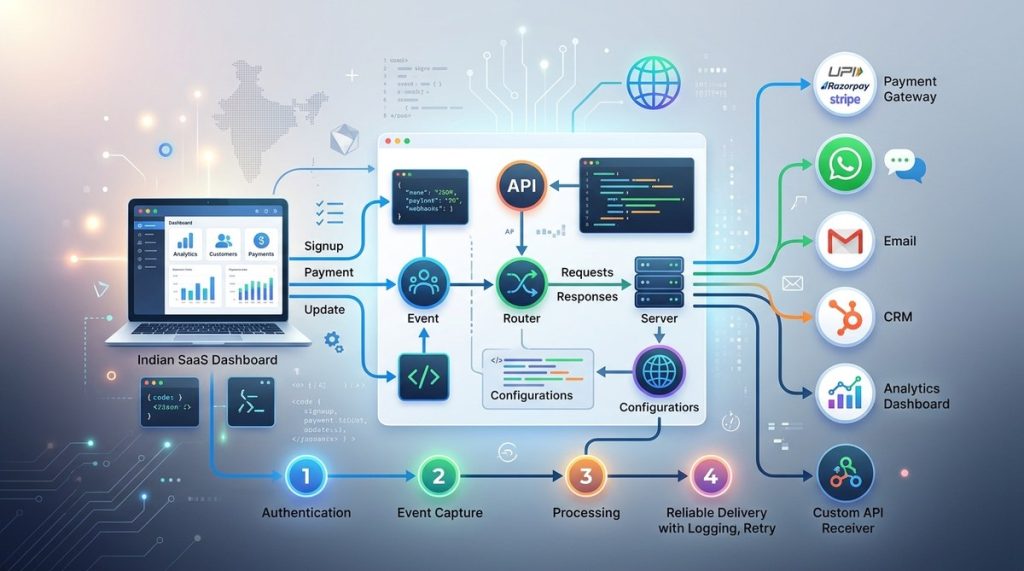
Your SaaS platform is growing. You have customers in Mumbai, Bengaluru, and Pune. They all expect real-time updates when an invoice is paid or a user signs up. You could pay a third-party webhook provider, but the costs add up fast. Or you could build your own system. It gives you control, saves money, and scales with your needs.
Building a custom webhook system for your Indian SaaS is a strategic move that reduces recurring costs and gives you full control over delivery. This guide walks you through the core architecture, payload signing, retry logic, and monitoring. You will learn how to design an event-driven pipeline that handles failures gracefully and scales with your user base in 2026.
Why Build Your Own Webhook System
Third-party webhook services charge per event. If your SaaS sends millions of events a month, those bills become a significant line item. Indian startups often operate on tight margins. Building in-house lets you redirect that money toward product development.
You also get full control over the delivery logic. You decide retry intervals, rate limits, and security protocols. No vendor lock-in. No surprise pricing changes.
A custom system also improves your uptime. When a third-party service goes down, your webhooks stop. When you own the pipeline, you can route around failures faster.
Core Architecture of a Webhook System
Before writing code, understand the moving parts. A webhook system has three main components:
- Event Producer: Your app logic that detects an event (like a payment success) and publishes it.
- Webhook Dispatcher: A worker service that reads events from a queue and sends HTTP POST requests to your customers’ endpoints.
- Delivery Log: A database that stores every attempt, response status, and timestamp.
You need a message queue in the middle. Redis, RabbitMQ, or Amazon SQS work well. The queue decouples event production from delivery. If your customers’ servers are slow, your app does not block.
Step-by-Step Implementation Plan
Follow these steps to build a production-ready webhook system.
1. Design Your Event Payload
Keep the payload simple and consistent. Every event should include:
event_id: A unique UUID for idempotency.event_type: A string likeinvoice.paidoruser.created.timestamp: The ISO 8601 time of the event.data: The actual payload with relevant fields.
Your customers will use event_id to ignore duplicate deliveries. This is critical because your retry logic will send the same event multiple times.
2. Set Up the Message Queue
Push events into a queue immediately after they happen. Do not send HTTP requests inside your request-response cycle. That will slow down your API.
# Example: Publishing an event to Redis
import redis, json, uuid
r = redis.Redis(host='localhost', port=6379)

event = {
    "event_id": str(uuid.uuid4()),
    "event_type": "invoice.paid",
    "timestamp": "2026-11-09T10:30:00Z",
    "data": {"invoice_id": "INV-2026-001", "amount": 1500}
}
r.lpush("webhook_queue", json.dumps(event))
3. Build the Dispatcher Worker
The worker pulls events from the queue and sends them to registered endpoints. It must handle timeouts and network errors.
import requests, json, time
from redis import Redis

r = Redis()
while True:
    event_json = r.brpop("webhook_queue", timeout=5)
    if event_json is None:
        continue
    event = json.loads(event_json[1])
    endpoint = get_customer_webhook_url(event["event_type"])
    try:
        resp = requests.post(endpoint, json=event, timeout=10)
        if resp.status_code == 200:
            log_success(event["event_id"])
        else:
            schedule_retry(event)
    except requests.exceptions.Timeout:
        schedule_retry(event)
4. Implement Retry Logic with Exponential Backoff
Not all deliveries succeed. Your system must retry with increasing delays. A common pattern is:
- First retry after 1 minute.
- Second retry after 5 minutes.
- Third retry after 15 minutes.
- Fourth retry after 1 hour.
- Stop after 5 attempts.
Store retry counts in your database. If a webhook fails after the maximum attempts, mark it as dead and alert your team.
5. Sign Your Payloads for Security
Your customers need to trust that the webhook came from you. Sign each payload with an HMAC-SHA256 signature using a shared secret.
import hmac, hashlib

secret = b"your-shared-secret"
payload = json.dumps(event, separators=(',', ':'))
signature = hmac.new(secret, payload.encode(), hashlib.sha256).hexdigest()
headers = {"X-Webhook-Signature": signature}
Your customers verify the signature on their end. This prevents spoofing.
6. Add a Dashboard for Monitoring
Your team needs visibility into webhook health. Build a simple dashboard that shows:
- Total events sent in the last 24 hours.
- Success rate per endpoint.
- Failed deliveries with error codes.
- Retry queue depth.
A good monitoring setup helps you catch problems before customers complain.
Common Pitfalls and How to Avoid Them
| Mistake | Why It Hurts | How to Fix It |
|---|---|---|
| Blocking the main thread | Your API becomes slow for all users | Use a message queue and async workers |
| No idempotency keys | Customers process duplicate payments | Include a unique event_id in every payload |
| Ignoring endpoint timeouts | Workers hang indefinitely | Set a strict timeout of 10 seconds |
| Using a single queue | A slow endpoint blocks others | Use separate queues per priority level |
| No logging | You cannot debug failures | Log every attempt with timestamps |
Choosing the Right Tech Stack
Your tech stack depends on your team’s comfort and existing infrastructure. Here are three popular options for Indian SaaS teams in 2026:
- Node.js with Bull (Redis): Great if you already use Node.js. Bull provides built-in retries and job scheduling.
- Python with Celery: A solid choice for Django or Flask apps. Celery handles task queues and retries natively.
- Go with RabbitMQ: Ideal for high-throughput systems. Go’s concurrency model handles thousands of webhook deliveries per second.
“A well-designed webhook system is a force multiplier for your platform. It lets your customers build integrations without waiting for you to build them.” — A senior backend engineer at a Bangalore-based SaaS company.
Testing Your Webhook System
You cannot ship a webhook system without testing it thoroughly. Use these strategies:
- Unit tests: Test your payload signing and retry logic in isolation.
- Integration tests: Spin up a local HTTP server that simulates a customer endpoint. Send events and verify delivery.
- Failure simulation: Make your test server return 500 errors or time out. Confirm your retry logic works correctly.
- Load testing: Use tools like k6 or Locust to send thousands of events per second. Check that your queue does not overflow.
If you are new to load testing, read our guide on how to optimize database queries for high-traffic websites to prepare your storage layer.
Scaling for Indian Traffic Patterns
Indian SaaS platforms often see uneven traffic. You might get a burst of signups during a Diwali promotion or a spike in invoice payments at the end of the financial year. Your webhook system must handle these surges.
Use horizontal scaling for your worker processes. Run multiple instances of your dispatcher behind a load balancer. Each worker pulls from the same queue. This spreads the load evenly.
Also, consider using a managed queue service like Amazon SQS or Google Cloud Pub/Sub. They handle backpressure automatically. If your customers’ endpoints are slow, the queue absorbs the excess events without losing data.
Security Best Practices for Indian SaaS
Data security is a growing concern, especially with India’s upcoming data localization laws. Your webhook system must protect customer data.
- Use HTTPS only: Never send webhooks over plain HTTP.
- Rotate secrets regularly: Share a new secret with each customer every 90 days.
- Allow IP whitelisting: Let customers restrict incoming webhooks to your server’s IP range.
- Log access: Keep a record of every webhook delivery for compliance.
For more on this topic, check out our article on 5 essential security practices every web developer in India must follow.
When to Reconsider Building Your Own
Building a custom webhook system is not always the right call. If you have fewer than 10,000 events per month, a third-party service might be cheaper when you factor in development time. Also, if your team lacks experience with message queues and retry logic, you could introduce bugs that lose customer data.
Start with a third-party provider and migrate to a custom system once your event volume justifies the effort. Many Indian SaaS companies make this switch when they hit around 500,000 events per month.
Your Roadmap for the Next 30 Days
Here is a practical plan to build your webhook system without disrupting your existing product.
- Week 1: Design your event payload schema and set up a Redis queue. Write the code to publish events from your main app.
- Week 2: Build the dispatcher worker with basic retry logic. Use a simple polling loop.
- Week 3: Add payload signing and a database table to log deliveries. Write unit tests for retry scenarios.
- Week 4: Deploy the system to a staging environment. Run load tests. Monitor for a week before going to production.
Owning Your Integration Pipeline
A custom webhook system is one of those infrastructure projects that pays for itself over time. You stop paying per-event fees. You move faster when customers request new event types. And you sleep better knowing your delivery pipeline is under your control.
Start small. Build the core loop with a queue and a worker. Add retries and security later. Your future self will thank you when your SaaS hits its next growth milestone and the webhooks keep flowing without a hiccup.
If you are looking for more ways to optimize your development workflow, take a look at our guide on 10 essential web development tools that will save your startup hours in 2026.