Your users in India expect speed. They expect your app to load instantly, whether they are in a metro city like Bengaluru or a tier-2 town like Lucknow. They expect real-time updates, live dashboards, and instant notifications. If your app lags, they leave. That is the reality of the Indian market in 2026. And this is exactly why so many Indian startups are making the shift to edge computing for their real-time web applications.
Edge computing brings your application logic and data storage closer to your users. For Indian startups building real-time apps, this means lower latency, reduced bandwidth costs, and better performance during traffic spikes. It is not just a trend. It is a practical infrastructure choice that helps you retain users and scale efficiently across India’s diverse geography.
What is Edge Computing and Why Does It Matter for Your Startup?
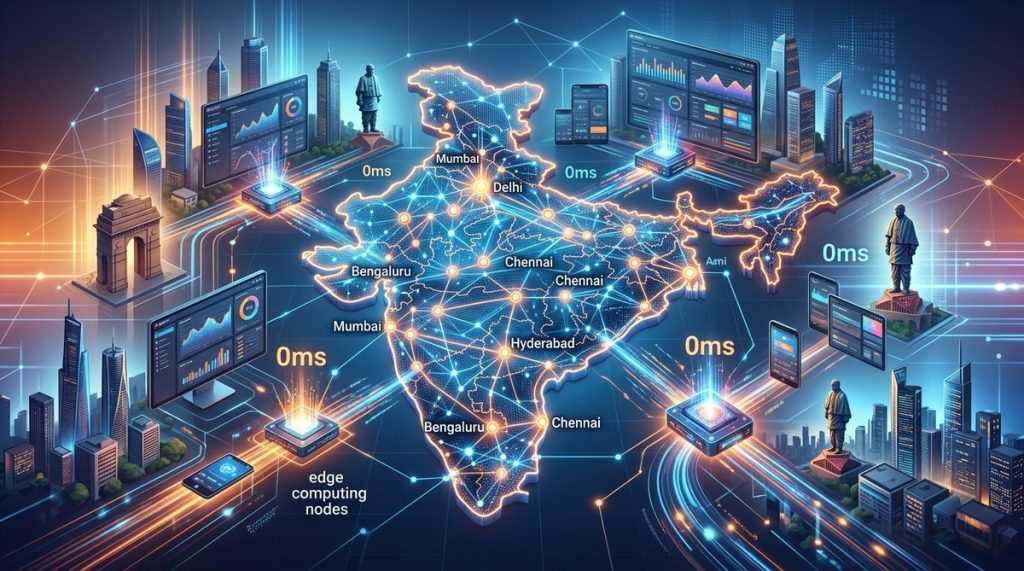
Think of edge computing as a smarter way to handle data. Instead of sending every request from a user in Mumbai to a central server in Virginia or even Frankfurt, edge computing processes that data at a nearby location. That nearby location could be a server in Mumbai itself, or in a colocation facility in Delhi NCR.
For a real-time web application, this difference is massive. When you build a live collaboration tool, a real-time analytics dashboard, or a multiplayer gaming platform, every millisecond counts. A delay of 200 milliseconds can feel like an eternity to a user waiting for a live score update during a cricket match.
Traditional cloud computing works well for many things. But for real-time apps, the physical distance between the user and the server becomes a bottleneck. Edge computing solves this by placing your application’s compute power at the “edge” of the network, closer to the end user.
The Real Problem Indian Startups Face with Centralized Cloud
Let us break down the specific pain points that drive Indian startups toward edge computing.
Latency is a User Retention Killer
India is not a single geography. The internet infrastructure varies wildly between cities. A user in Delhi might have a 10ms ping to a server in Noida, but a user in Guwahati might have a 100ms ping to the same server. If your app requires real-time synchronization, that difference breaks the experience.
Consider a food delivery startup that uses real-time tracking. If the delivery partner’s location updates with a 5-second delay, the user gets frustrated. Edge computing can process that location data at a regional edge node, reducing the update delay to under a second.
Bandwidth Costs Add Up
Indian startups often operate on tight budgets. Sending all data to a central server consumes bandwidth. For a real-time video streaming platform or a live trading app, this cost can become unsustainable. Edge computing processes data locally and only sends necessary information to the central server. This reduces your cloud bandwidth bill significantly.
Reliability During Peak Hours
Indian internet traffic spikes during festivals, flash sales, and major events. A centralized server can get overwhelmed. Edge nodes distribute the load. If one node goes down, another edge node nearby can take over. This makes your real-time app more resilient.
How Indian Startups Are Using Edge Computing for Real-Time Apps
The use cases are growing fast. Here are three practical examples from the Indian startup ecosystem in 2026.
- Live E-Commerce Auctions: Startups running real-time bidding platforms for electronics or collectibles use edge nodes to process bids locally. This ensures that the highest bid is recorded without lag.
- Real-Time EdTech Platforms: EdTech startups use edge computing to power live classes with interactive quizzes. Student responses are processed at the nearest edge node, and the results appear on the teacher’s dashboard instantly.
- Logistics and Fleet Management: Startups tracking delivery fleets use edge computing to process GPS data at regional nodes. This allows them to provide real-time ETAs to customers without sending every location ping to a central server.
A Practical Guide: How to Migrate Your Real-Time App to Edge Computing
If you are a CTO or product manager evaluating this shift, here is a step-by-step process to follow.
-
Audit your current latency profile. Use tools to measure the average response time for users in different Indian cities. Identify the regions where latency is highest.
-
Choose your edge provider. Several providers offer edge computing solutions specifically for Indian startups. Look for providers with points of presence (PoPs) in multiple Indian cities, including tier-2 and tier-3 locations.
-
Refactor your application for distribution. Your app needs to handle state management across multiple edge nodes. This often means moving from a monolithic backend to a microservices architecture. You can learn more about this in our guide on 5 microservices best practices for scalable web applications.
-
Implement a local-first data strategy. Your app should write data to the nearest edge node first. Then, asynchronously sync that data to your central database. This ensures speed for the user and consistency for your business logic.
-
Test with real traffic. Run A/B tests comparing your centralized setup with the edge setup. Measure the difference in page load time, API response time, and user retention.
Common Mistakes to Avoid When Moving to Edge Computing
Switching to edge computing is not without challenges. Here are some mistakes Indian startups make, along with how to avoid them.
| Mistake | Why It Hurts | How to Fix It |
|---|---|---|
| Ignoring data consistency | Real-time apps need synchronized data. If your edge nodes are out of sync, users see stale information. | Use a conflict-free replicated data type (CRDT) or a distributed database that supports eventual consistency. |
| Choosing the wrong edge locations | Placing nodes only in metros ignores 60% of your user base in smaller cities. | Analyze your user data. Place edge nodes where your users actually are, not just where it is convenient. |
| Not caching static assets | Edge computing is not just for compute. If you do not cache images, CSS, and JavaScript at the edge, you still suffer from slow load times. | Use a content delivery network (CDN) in tandem with your edge compute. Our article on why your website needs a content delivery network for faster load times explains this in detail. |
“The biggest mistake I see is startups treating edge computing as a magic bullet. It is a tool. You need to design your application architecture to take advantage of it. If you just move your existing monolith to an edge node, you will not see the full benefit.” – Ravi Sharma, CTO of a Series A logistics startup in Bengaluru.
The Role of Real-Time Web Technologies in an Edge Setup
Edge computing works best when paired with the right real-time technologies. For example, WebSockets allow persistent connections between the user and the edge node. This is ideal for live chat, notifications, and collaborative editing. You can read our guide on how to implement websockets for real-time chat and notifications in indian web apps for a technical walkthrough.
Similarly, serverless functions deployed at the edge can handle authentication, data validation, and simple business logic without the overhead of a full server. This is a great way to start your edge journey without a massive rewrite.
Why 2026 is the Right Year for Indian Startups to Make the Switch
Several factors make 2026 a pivotal year for edge computing adoption in India.
First, the cost of edge infrastructure has dropped. Providers now offer pay-as-you-go pricing that fits startup budgets.
Second, the user base in India is more demanding than ever. With Jio and Airtel expanding 5G coverage, users expect sub-100ms response times. If your app cannot deliver that, they will switch to a competitor.
Third, the ecosystem of tools and frameworks has matured. You no longer need a dedicated infrastructure team to manage edge deployments. Platforms like Vercel, Cloudflare Workers, and AWS Lambda@Edge have made it accessible.
Measuring the Impact: Metrics You Should Track
Once you make the switch, you need to measure success. Here are the key metrics to monitor.
- Time to first byte (TTFB): Measure this for users in different regions. A drop of 50% or more is a good sign.
- API response time: Track the average response time for your real-time endpoints.
- User retention rate: Compare the retention of users in high-latency regions before and after the migration.
- Bandwidth cost per user: Calculate your cloud egress costs. You should see a reduction.
How to Start Small and Scale
You do not need to move your entire application to edge computing overnight. Start with one feature. For example, move your real-time notification system to an edge node. See how it performs. Then expand to other features like live search or real-time analytics.
This approach reduces risk and gives your team time to learn the nuances of distributed state management. It also lets you build a business case for the full migration.
The Future of Real-Time Web Apps in India
Edge computing is not a passing phase. It is becoming the standard for any application that cares about user experience. Indian startups that adopt it now will have a significant advantage over those that wait. The combination of edge computing, real-time web technologies, and a user-centric design approach is what will define the next generation of successful Indian web apps.
If you are building a real-time dashboard, a live streaming platform, or a collaborative tool, now is the time to evaluate your infrastructure. The tools are ready. The costs are manageable. And your users are waiting for a faster experience.
Your Next Steps for Building a Faster, More Reliable Real-Time App
Start by auditing your current performance. Identify the regions where your app struggles. Then pick one feature to move to the edge. Use the metrics we discussed to validate the improvement. Once you see the results, you will likely want to move more features.
Remember, the goal is not to adopt edge computing for the sake of it. The goal is to give your users a seamless, real-time experience that keeps them coming back. Edge computing is simply the best tool for that job in 2026.
For more practical advice on building better web applications, check out our guide on how to build a real-time dashboard with websockets for your indian e-commerce site. It walks you through the exact implementation steps using edge-friendly technologies.