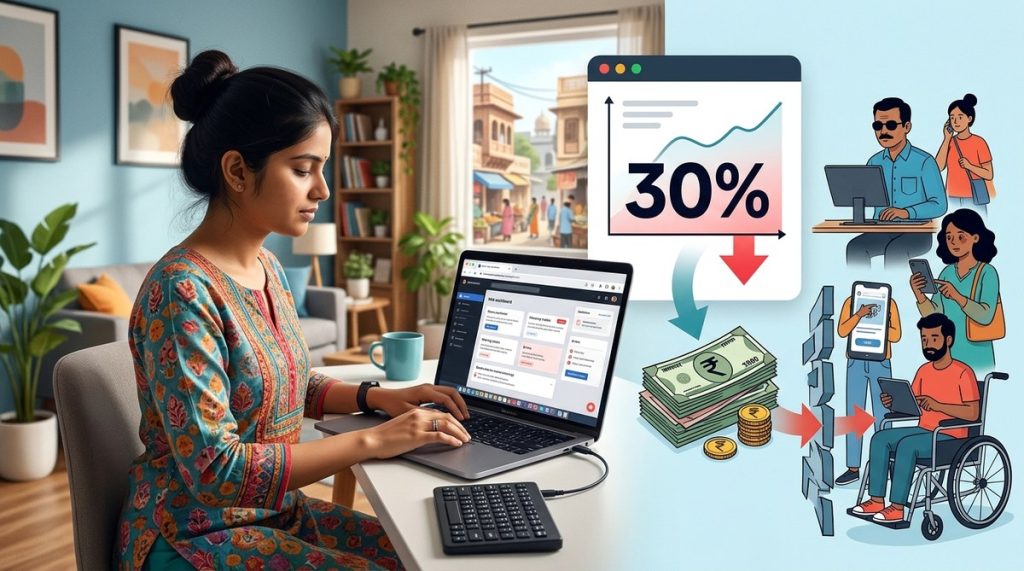
Your web app is losing money every single day. You just do not see it yet.
If your product is not built for people with disabilities, you are actively turning away a massive chunk of India’s user base. We are not talking about a tiny niche. We are talking about over 30 crore Indians who live with some form of disability. That is bigger than the entire population of many countries. And they use the internet. They shop online. They book cabs. They order food. They just cannot use your app.
The cost of ignoring web accessibility is not a future risk. It is a present day revenue leak. Here is the real price you are paying.
Ignoring web accessibility costs Indian businesses crores in lost revenue, legal risks, and poor SEO. With over 30 crore potential users excluded, inaccessible apps lose up to 30% of their addressable market. Prioritizing accessibility is not charity. It is a direct business growth strategy that improves UX for everyone and boosts your bottom line.
The Hidden Revenue Leak You Cannot Afford
Think about your last product meeting. You probably debated new features, UI tweaks, and conversion funnels. Did anyone ask how a blind person would use your checkout page? Probably not. That silence is costing you.
India has one of the largest populations of people with disabilities in the world. According to the World Bank, about 15% of the global population lives with some form of disability. For India, that translates to roughly 30 crore people. These are not just numbers. These are real users with real purchasing power.
A person with low vision might use a screen reader to navigate your site. Someone with motor impairment might rely entirely on a keyboard. A user with hearing loss needs captions for your product videos. If your web app fails these users, they leave. And they do not come back.
Here is the hard truth: 71% of users with disabilities will leave a website that is difficult to use. They will go to a competitor who treats them better. That is not a small leakage. That is a flood.
Legal Trouble Is Closer Than You Think
India’s Rights of Persons with Disabilities Act, 2016, mandates equal access for people with disabilities. The government has been pushing for WCAG 2.1 compliance for all public facing websites. While private companies have not faced a wave of lawsuits yet, the legal landscape is shifting.
Globally, companies like Domino’s and Target have faced expensive lawsuits over inaccessible websites. In India, the conversation is growing louder. The Department of Empowerment of Persons with Disabilities has issued accessibility guidelines. It is only a matter of time before courts start holding private businesses accountable.
The cost of ignoring web accessibility includes potential legal fees, settlement costs, and mandatory remediation orders. A lawsuit can easily run into several lakhs or even crores. That is money you could have spent on building the right features from the start.
“Accessibility is not a feature. It is a fundamental aspect of good product design. Ignoring it is like building a store with stairs and no ramp. You are telling a significant part of your audience that they are not welcome.” — Ravi Sharma, accessibility consultant based in Bengaluru
How Accessibility Boosts Your SEO and Organic Traffic
Here is a secret that many marketers miss. Google loves accessible websites. The same things that make a site accessible for people with disabilities also make it rank higher in search results.
- Proper heading structures help screen readers and Google bots understand your content.
- Alt text for images improves your image search rankings.
- Good color contrast makes your text readable for everyone, including search engine crawlers.
- Video captions provide more text content for Google to index.
- Fast loading times benefit users with cognitive disabilities and improve your Core Web Vitals.
When you fix accessibility, you are essentially optimizing your site for SEO. The cost of ignoring web accessibility includes lower rankings, less organic traffic, and higher ad spend to compensate.
For a deeper look at how these principles work together, check out our guide on mastering user experience in web design for better conversion rates. It covers how inclusive design directly impacts your bottom line.
The Real Numbers You Need to See
Let us put some rough numbers on this. Assume your web app gets 1 lakh visitors per month. If 15% of those visitors have a disability, that is 15,000 users. If 71% of them leave because your site is hard to use, you lose about 10,650 visitors every month.
Now apply your conversion rate. Even a modest 2% conversion rate on those lost visitors means 213 lost customers per month. If your average customer lifetime value is Rs. 5,000, that is over Rs. 10 lakh in lost monthly revenue. That is over Rs. 1.2 crore per year.
And that is a conservative estimate. For a larger app, the numbers scale dramatically.
Common Accessibility Mistakes and How to Fix Them
Most accessibility problems come from a few common mistakes. Here is a table that shows what to avoid and what to do instead.
| Common Mistake | What It Looks Like | The Fix |
|---|---|---|
| Missing alt text | Images with no description | Add descriptive alt text for every image |
| Poor color contrast | Light grey text on white background | Use a contrast ratio of at least 4.5:1 |
| No keyboard support | User cannot Tab through the page | Ensure all interactive elements are reachable via keyboard |
| Missing form labels | Form fields with no label tag | Associate every input with a <label> element |
| No caption on videos | Video content with no text alternative | Add captions or provide a transcript |
| Using color alone to convey information | Red text for “required fields” | Add an asterisk or text label alongside the color |
Fixing these mistakes is often simpler than you think. You do not need a complete redesign. You need a systematic approach.
A Simple Process to Start Your Accessibility Journey
You do not have to fix everything at once. Here is a practical process you can start this week.
-
Run an automated audit using a free tool like WAVE or axe DevTools. This will catch about 30% of common issues. It is a good starting point but not enough on its own.
-
Do a manual keyboard test. Unplug your mouse and try to use your entire web app using only the Tab, Enter, and arrow keys. If you get stuck anywhere, you have found a problem.
-
Test with a screen reader. Download a free screen reader like NVDA (Windows) or VoiceOver (Mac). Close your eyes and try to complete a core user flow. Listen to how your content is announced. You will be surprised at what you hear.
-
Create a simple accessibility checklist based on WCAG 2.1 Level AA. Share it with your development team. Make it part of your definition of done for every new feature.
-
Involve real users. The best way to understand accessibility is to watch someone who relies on it use your product. Their feedback is priceless.
For more on building a solid technical foundation, read our guide on essential web development tools every startup should use. Many of these tools include built in accessibility checkers.
Why Your Competitors Are Already Doing This
Big brands in India are waking up. Flipkart, Amazon India, and many banking apps have invested heavily in accessibility. They know that the next wave of users will come from smaller towns and older demographics. These users often have different accessibility needs.
If your startup ignores this, you are handing your competitors a ready made audience. When a user with a disability finds a site that works for them, they become fiercely loyal. They tell their friends. They become your best marketers.
The cost of ignoring web accessibility is not just about losing users. It is about giving your competition a free win.
The Business Case in One Table
Here is a summary of why accessibility matters for your bottom line.
| Factor | Impact | Why It Matters |
|---|---|---|
| Addressable market | Over 30 crore potential users in India | Largest untapped audience for most apps |
| User retention | 71% of disabled users leave inaccessible sites | Direct revenue loss every month |
| SEO performance | Accessible sites rank higher | Lower ad costs and more organic traffic |
| Legal risk | Growing regulatory pressure in India | Avoid lawsuits and compliance fines |
| Brand perception | Inclusive brands are trusted more | Stronger customer loyalty and word of mouth |
Start with One Small Win
You do not need a massive budget to begin. Start with one user flow. Maybe it is the login page or the product search. Make that flow fully accessible. Test it. Learn from it. Then expand.
Accessibility is a journey, not a destination. Every small improvement you make opens your product to more people. It makes your code cleaner, your UX better, and your business stronger.
The Real Cost of Doing Nothing
Let us be honest. The biggest cost of ignoring web accessibility is not legal fees or lost revenue. It is the trust you lose from real people who want to use your product. It is the missed opportunity to build a brand that truly serves everyone.
India is a diverse country. Your web app should reflect that. When you build for accessibility, you build for scale. You build for the future. You build for the 30 crore users who are waiting for a product that sees them.
If you want to learn more about building for modern audiences, check out our article on how to build responsive web designs that drive Indian users engagement in 2026. It covers how inclusive design fits into a larger strategy.
Your Next Step
Pick one page from your web app today. Run the keyboard test. Add alt text to the images. Check the color contrast. It will take you less than an hour. That hour could be the start of a much bigger change.
The cost of ignoring web accessibility is real. But the reward of embracing it is even bigger. More users, better SEO, stronger brand, and a product that truly works for everyone.
Start today. Your users are waiting.